Begin of page section:
Page sections:

  • Go to contents (Accesskey 1)
  • Go to position marker (Accesskey 2)
  • Go to main navigation (Accesskey 3)
  • Go to sub navigation (Accesskey 4)
  • Go to additional information (Accesskey 5)
  • Go to page settings (user/language) (Accesskey 8)
  • Go to search (Accesskey 9)

End of this page section. Go to overview of page sections

Begin of page section:
Page settings:

English en
Deutsch de
Search
Login

End of this page section. Go to overview of page sections

Begin of page section:
Search:

Search for details about Uni Graz
Close

End of this page section. Go to overview of page sections


Search

Begin of page section:
Main navigation:

Page navigation:

  • University

    University
    • About the University
    • Organisation
    • Faculties
    • Library
    • Working at University of Graz
    • Campus
    Developing solutions for the world of tomorrow - that is our mission. Our students and our researchers take on the great challenges of society and carry the knowledge out.
  • Research Profile

    Research Profile
    • Our Expertise
    • Research Questions
    • Research Portal
    • Promoting Research
    • Research Transfer
    • Ethics in Research
    • Commission for Scientific Integrity
    Scientific excellence and the courage to break new ground. Research at the University of Graz creates the foundations for making the future worth living.
  • Studies

    Studies
    • Prospective Students
    • Students
    • Registration for Study Programme (Winter semester 2026/27)
  • Community

    Community
    • International
    • Location
    • Research and Business
    • Alumni
    The University of Graz is a hub for international research and brings together scientists and business experts. Moreover, it fosters the exchange and cooperation in study and teaching.
Topics
  • Sustainable University
  • Researchers answer
  • Work for us
Close menu

End of this page section. Go to overview of page sections

Begin of page section:
You are here:

University of Graz News Wissenschaft trifft Blockbuster: Campus-Kino im Innenhof

End of this page section. Go to overview of page sections

Monday, 22 June 2026

Science meets blockbuster: Campus cinema at the University of Graz

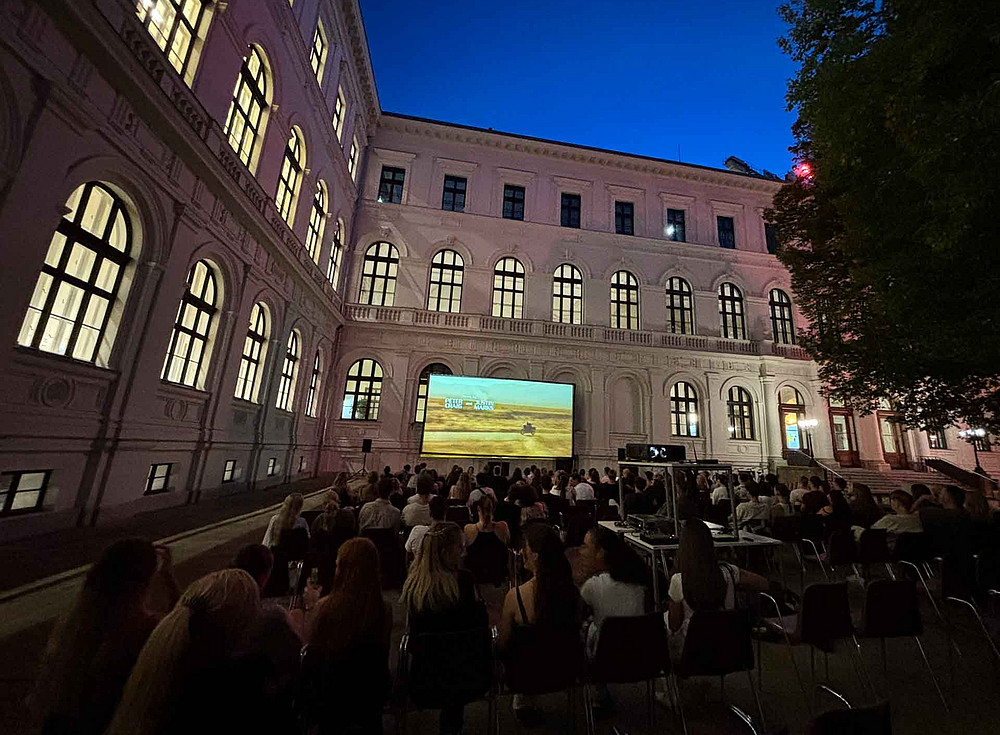
In the evenings, many young adults sit on chairs in the courtyard in front of a screen and watch a film, surrounded by a historic building. ©Uni Graz/Schweiger
©Uni Graz/Schweiger

For two weeks, the courtyard of the university’s main building is transformed into one of the city’s most beautiful open-air cinemas. Photo: Uni Graz/Schweiger

A cinematic treat for the scientific community: the courtyard of the University of Graz’s main building is once again being transformed into an atmospheric open-air cinema this year. From 29 June to 10 July 2026 (Mondays to Fridays from 8.30 pm), blockbusters and documentaries will be shown on the open-air screen. Academics from the University of Graz will be taking a closer look at the films shown, examining them to distinguish fact from fiction.

In the introduction to “Jurassic World: A New Age” (9 July), molecular biologist Kai-Uwe Fröhlich explains whether dinosaurs and mammoths could really be brought back to life.
Sociologist Karin Scaria-Braunstein provides an introduction to the courtroom drama “She Says. He Says.” by Ferdinand von Schirach (2 July) and explains how our society deals with conflict.
Each episode is presented by Fritz Treiber, molecular biologist and nutrition expert on the ORF programme “Studio 2”.

The finale on 10 July will be presented by Treiber and historian Margit Linder with a new episode of “Science & Cinema”. They will explore the facts and fiction in films centred on ancient Greece. Excerpts from “Alexander”, “Asterix at the Olympic Games” and “Troy” will be shown.

In the event of bad weather, the Campus Cinema will be moved to the Alumni Lecture Theatre (Library).
The full film programme and tickets (€6) are available at: https://campus-kino.uni-graz.at

A leading role for research

A recent study by the University of Graz confirms that cinema, when combined with science, offers added value. Researchers from the 7th Faculty, the Centre for Society, Knowledge and Communication, demonstrate that conveying knowledge through films can positively influence understanding of scientific topics. 
The study was carried out as part of two events in the University of Graz’s ‘Science & Cinema’ series in 2022. During these events, geophysicist Ulrich Foelsche explored climate change using selected films, including clips from “The Day After Tomorrow”, “A.I.” and “Mad Max”.

The audience was surveyed before and after the events; their responses formed the basis for the analysis carried out by an interdisciplinary research team. Author Hildrun Walter summarises: “The film sequences, with their music, powerful imagery and gripping plots, evoke emotions; this can be harnessed as a learning opportunity for often complex content.” On the one hand, they capture the audience’s attention; on the other, the impressions encourage people to actively question the facts.
The conclusion: most visitors felt better informed after the event and were better able to assess the background to climate change. “Cinema becomes a vehicle for science and, at the same time, opens up new target audiences,” the researcher emphasises.
The publication has appeared in the Journal of Science Communication.
created by Andreas Schweiger

Related news

Frauen-geführte Farmer Producer Companies in indischen Tribal Communities

Am Institut für Marketing der SoWi-Fakultät der Universität Graz untersuchen Dr. Ankita Singh und Professor Vishal Kashyap, wie von Frauen geführte Farmer Producer Companies (FPCs) in indischen Tribal Communities ihren Weg in den Markt finden und unter schwierigen Rahmenbedingungen nachhaltige Geschäftsmodelle entwickeln.

Univ.-Prof. Dr. Ulrich Pferschy mit dem Test of Time paper Award ausgezeichnet!

Große Anerkennung für die Forschung an der Sozial- und Wirtschaftswissenschaftlichen Fakultät: Prof. Ulrich Pferschy wurde gemeinsam mit seinen Co-Autoren Jakob Puchinger und Günther R. Raidl mit dem „Test of Time Paper Award“ des INFORMS Journal on Computing ausgezeichnet.

Oral History in Graz: Wie Unternehmensgeschichte zur Zukunftsressource wird

Das Grazer Oral-History-Archiv macht sichtbar, wie Unternehmen aus Erinnerungen lernen können: Gespräche mit Unternehmer:innen und Zeitzeug:innen liefern wertvolle Einblicke in Krisenbewältigung, Wandel und den Umgang mit schwierigen Kapiteln der Unternehmensgeschichte.

FiRe-Lecture 2026: OeNB-Gouverneur Martin Kocher zu Gast an der SOWI-Fakulät

Die SOWI-Fakultät begrüßt im Rahmen der FiRe-Lecture 2026 Univ.-Prof. Dr. Martin Kocher, Gouverneur der Oesterreichischen Nationalbank und Mitglied im Rat der Europäischen Zentralbank. Im Fokus der Veranstaltung stehen verhaltensökonomische Perspektiven und ihre Bedeutung für die Geldpolitik in der Eurozone.

Begin of page section:
Additional information:

University of Graz
Universitaetsplatz 3
8010 Graz
Austria
  • Contact
  • Web Editors
  • Moodle
  • UNIGRAZonline
  • Imprint
  • Data Protection Declaration
  • Accessibility Declaration
Weatherstation
Uni Graz

End of this page section. Go to overview of page sections

End of this page section. Go to overview of page sections

Begin of page section:

End of this page section. Go to overview of page sections